


Home / News
From Mashrabiya to Modern Screens: Privacy in Architecture and What It Means for Dubai Villas Today
March 24, 2026
Privacy has long shaped residential architecture across the Middle East. Well before contemporary façade systems or smart glazing technologies, traditional homes relied on passive design strategies to create protection, dignity and environmental comfort. In today’s luxury residential landscape in Dubai, these principles are not being replaced. They are being reinterpreted.
For clients working with a luxury architect Dubai or a top architectural firm Dubai, privacy is no longer defined simply as separation from neighbours. It is understood as a layered architectural condition, shaped by façade articulation, spatial sequencing, landscape planning and intelligent systems. Among Dubai architects and the best architecture firms in Dubai, privacy has become a central driver of long term luxury villa design Dubai and future proof residential architecture UAE. As villa design UAE evolves, traditional elements such as the Mashrabiya are being translated into contemporary materials and construction techniques. This reinterpretation is now a defining characteristic of luxury home design Dubai, particularly across Palm Jumeirah and other prime coastal environments where openness and exposure must coexist with discretion.
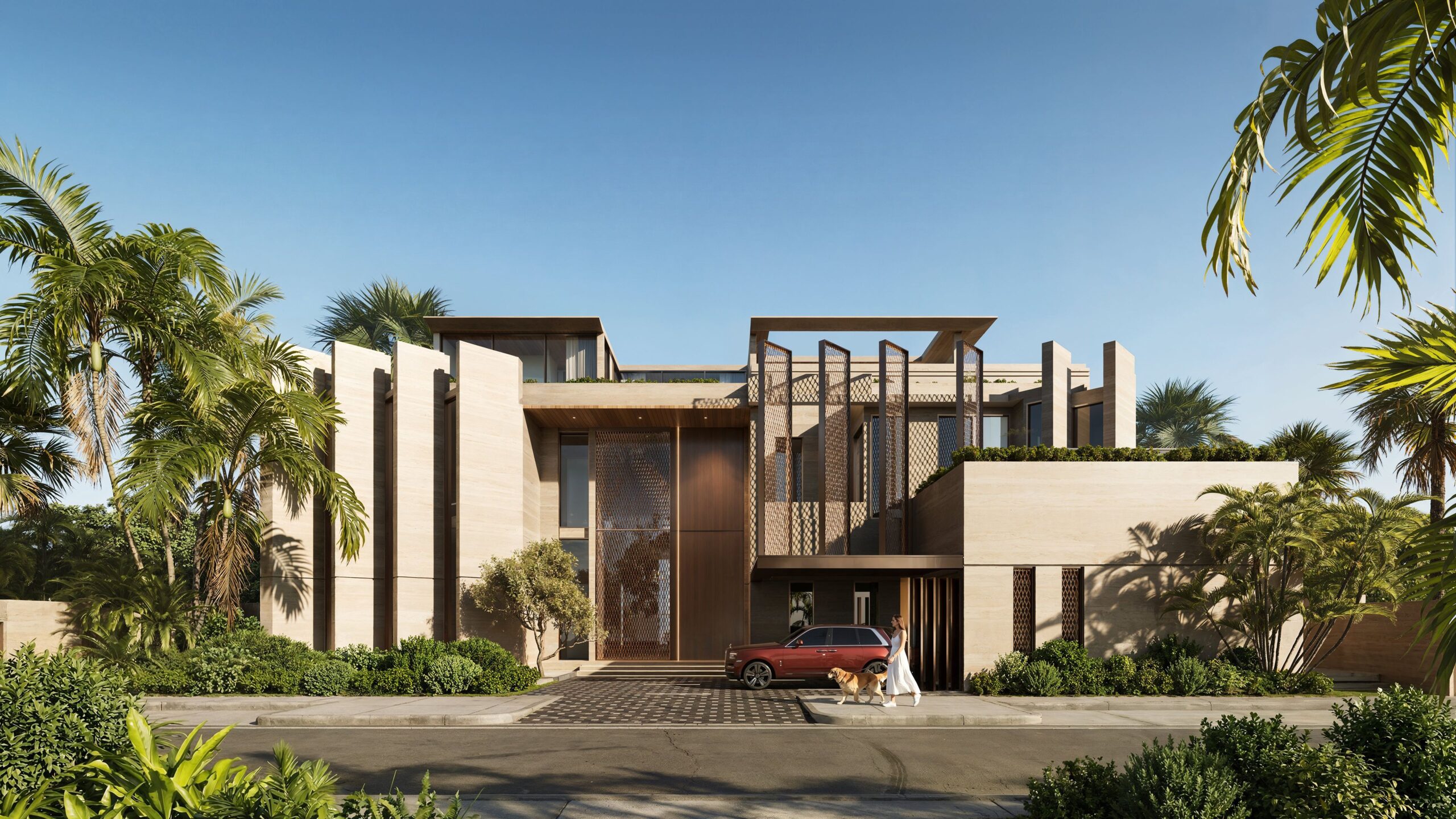
Historically, the Mashrabiya performed several functions at once. It filtered light, allowed ventilation and maintained visual privacy, enabling connection to the outside while protecting the interior. Today, architecture firms in Dubai are exploring similar principles through perforated metal screens, recessed glazing and layered façade systems. As Lee Nellis often notes, the most effective privacy strategies are rarely overt. They are integrated into the architecture itself, subtle and spatial rather than decorative.
Projects led by a considered luxury villa architect Palm Jumeirah increasingly rely on façade depth, articulation and landscape integration to create privacy without sacrificing openness. Careful architecture project management Dubai is essential in delivering these complex envelope strategies accurately, particularly when working with high performance glazing, bespoke screening and composite materials. In this context, privacy is not a late stage addition but a fundamental architectural framework.
Privacy as a Layered Architectural Strategy
 Future proof residential architecture UAE recognises that privacy is not achieved through a single design gesture. Boundary walls and hedges may create visual separation, but they rarely deliver emotional comfort. Instead, contemporary architectural design services approach privacy as a sequence of calibrated decisions involving orientation, façade depth, internal zoning and external screening.
From the earliest concept sketches, teams working on luxury villa design consider sightlines, circulation and acoustic buffering. Dubai villa interior design and villa interior design Dubai increasingly align with architectural planning to ensure privacy is embedded spatially rather than imposed cosmetically.
Interior design companies in Dubai are refining material palettes, joinery positioning and lighting strategies to reinforce these layers. Modern villa interior design often incorporates concealed storage, layered curtains, textured glazing and automated blinds to allow flexible control over exposure. Smart home automation strengthens this adaptability, enabling residents to adjust transparency, shading and lighting according to time of day and occupancy.
Adaptive glazing and automated shading systems allow homes to remain open to daylight while maintaining discretion. Yet, as Matas Belevicius often observes, while digital tools improve façade modelling and coordination, they cannot fully anticipate how privacy contributes to emotional security. Architecture remains deeply human, particularly when shaping family environments intended to endure for decades.
Sustainable architecture Dubai further reinforces privacy through passive design measures that reduce heat gain and glare while supporting internal comfort.
Façade Design, Climate Performance and Cultural Continuity
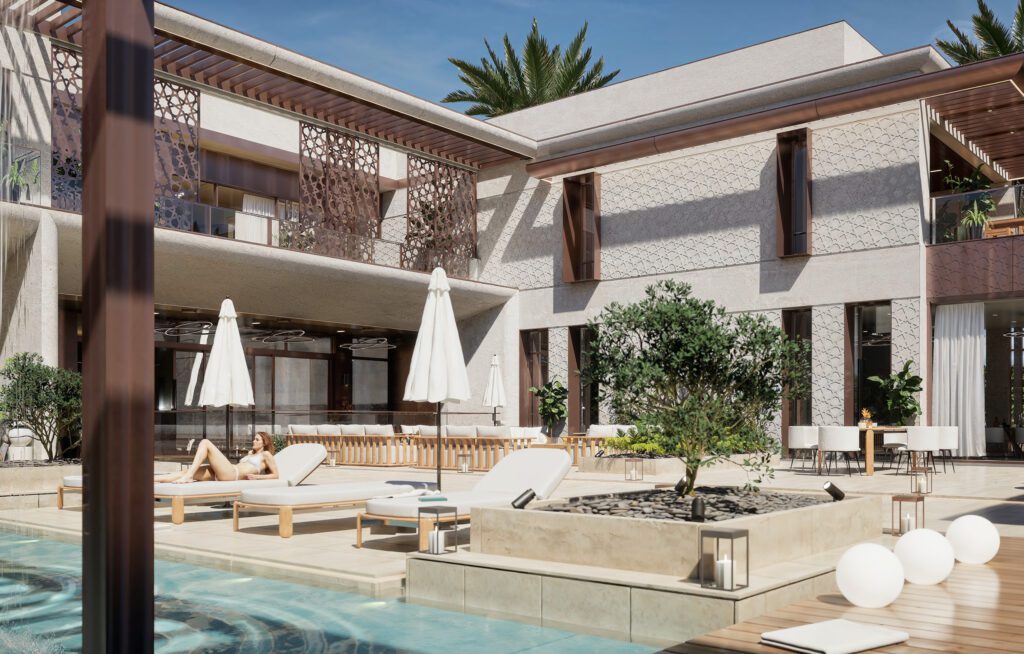
The contemporary reinterpretation of Mashrabiya is not merely aesthetic. It responds directly to climate performance and cultural continuity. Long term luxury villa design Dubai increasingly integrates perforated screens, stone lattices and composite panels that replicate the filtered light and airflow of traditional systems.
Luxury home design Dubai benefits significantly from these layered façades. Reduced solar gain, controlled glare and moderated daylight create interiors that feel calm rather than exposed. Sustainable architecture Dubai strategies often incorporate screening as a passive climate tool, supporting environmental performance while enhancing architectural depth.
3D modelling and visualisation allow design teams to explore screening density and better understand how light interacts with the architecture before construction begins. This analytical rigour ensures that façade strategies are not symbolic gestures but measurable contributors to comfort and energy efficiency.
Inside, luxury villa interior design and Dubai villa interior design respond to these filtered light conditions through warmer materials and softer lighting compositions. As Quinton Murdoch frequently notes, successful residential architecture is not about blocking light but about shaping it. Coastal and high density projects increasingly rely on layered screening to maintain privacy even in exposed waterfront settings, reinforcing long term design resilience.
Privacy as Emotional and Lifestyle Architecture
Beyond visual separation and environmental performance, privacy plays a profound role in wellbeing. Future proof residential architecture UAE acknowledges that the ability to modulate exposure supports relaxation, focus and social flexibility.
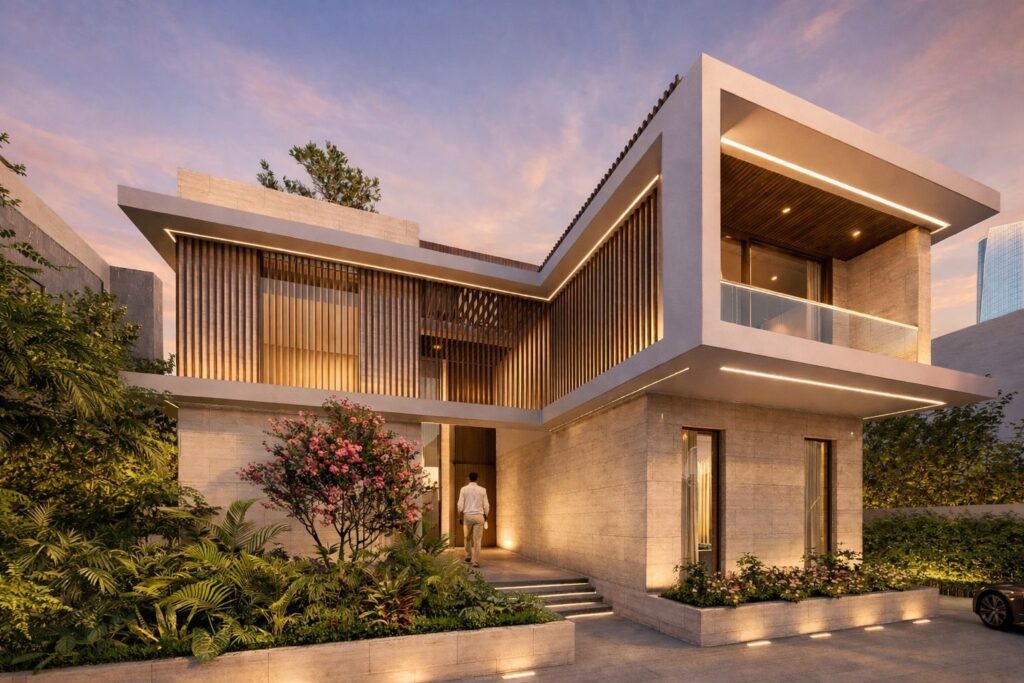
Luxury villa design now routinely incorporates graduated zones, from open arrival spaces to intimate internal retreats. Villa design UAE now often integrates spatial sequencing that gently transitions between public and private realms. Landscape architecture Dubai strengthens this strategy through planting density, topography and water features that buffer views and noise.
Within luxury villa interior design, acoustic control, lighting calibration and material warmth contribute to an atmosphere of calm. Interior design companies in Dubai are collaborating more closely with architecture firms to ensure that interior and exterior privacy strategies are aligned from the outset.
Smart home automation extends this sense of control, integrating blinds, glazing and security systems into a cohesive privacy framework. Sustainable architecture Dubai thinking also reduces environmental stress through passive measures that mitigate noise and glare.
As Lee Nellis often reflects, true luxury is not defined by exposure but by choice. In Dubai’s evolving residential market, the most enduring homes are those that balance openness with discretion. Among the best architecture firms in Dubai and top architecture companies in Dubai, privacy is increasingly understood as a measure of architectural intelligence, shaping how homes feel not only today, but across decades of ownership.
Design Intent Summary
This article positions privacy as a core architectural principle rooted in cultural heritage, climate performance and emotional wellbeing, reinforcing Nellis Architecture’s philosophy of layered design thinking and long term residential performance.
Future proof residential architecture UAE recognises that privacy is not achieved through a single design gesture. Boundary walls and hedges may create visual separation, but they rarely deliver emotional comfort. Instead, contemporary architectural design services approach privacy as a sequence of calibrated decisions involving orientation, façade depth, internal zoning and external screening.
From the earliest concept sketches, teams working on luxury villa design consider sightlines, circulation and acoustic buffering. Dubai villa interior design and villa interior design Dubai increasingly align with architectural planning to ensure privacy is embedded spatially rather than imposed cosmetically.
Interior design companies in Dubai are refining material palettes, joinery positioning and lighting strategies to reinforce these layers. Modern villa interior design often incorporates concealed storage, layered curtains, textured glazing and automated blinds to allow flexible control over exposure. Smart home automation strengthens this adaptability, enabling residents to adjust transparency, shading and lighting according to time of day and occupancy.
Adaptive glazing and automated shading systems allow homes to remain open to daylight while maintaining discretion. Yet, as Matas Belevicius often observes, while digital tools improve façade modelling and coordination, they cannot fully anticipate how privacy contributes to emotional security. Architecture remains deeply human, particularly when shaping family environments intended to endure for decades.
Sustainable architecture Dubai further reinforces privacy through passive design measures that reduce heat gain and glare while supporting internal comfort.
Façade Design, Climate Performance and Cultural Continuity
The contemporary reinterpretation of Mashrabiya is not merely aesthetic. It responds directly to climate performance and cultural continuity. Long term luxury villa design Dubai increasingly integrates perforated screens, stone lattices and composite panels that replicate the filtered light and airflow of traditional systems.
Luxury home design Dubai benefits significantly from these layered façades. Reduced solar gain, controlled glare and moderated daylight create interiors that feel calm rather than exposed. Sustainable architecture Dubai strategies often incorporate screening as a passive climate tool, supporting environmental performance while enhancing architectural depth.
3D modelling and visualisation allow design teams to explore screening density and better understand how light interacts with the architecture before construction begins. This analytical rigour ensures that façade strategies are not symbolic gestures but measurable contributors to comfort and energy efficiency.
Inside, luxury villa interior design and Dubai villa interior design respond to these filtered light conditions through warmer materials and softer lighting compositions. As Quinton Murdoch frequently notes, successful residential architecture is not about blocking light but about shaping it. Coastal and high density projects increasingly rely on layered screening to maintain privacy even in exposed waterfront settings, reinforcing long term design resilience.
Privacy as Emotional and Lifestyle Architecture
Beyond visual separation and environmental performance, privacy plays a profound role in wellbeing. Future proof residential architecture UAE acknowledges that the ability to modulate exposure supports relaxation, focus and social flexibility.
Luxury villa design now routinely incorporates graduated zones, from open arrival spaces to intimate internal retreats. Villa design UAE now often integrates spatial sequencing that gently transitions between public and private realms. Landscape architecture Dubai strengthens this strategy through planting density, topography and water features that buffer views and noise.
Within luxury villa interior design, acoustic control, lighting calibration and material warmth contribute to an atmosphere of calm. Interior design companies in Dubai are collaborating more closely with architecture firms to ensure that interior and exterior privacy strategies are aligned from the outset.
Smart home automation extends this sense of control, integrating blinds, glazing and security systems into a cohesive privacy framework. Sustainable architecture Dubai thinking also reduces environmental stress through passive measures that mitigate noise and glare.
As Lee Nellis often reflects, true luxury is not defined by exposure but by choice. In Dubai’s evolving residential market, the most enduring homes are those that balance openness with discretion. Among the best architecture firms in Dubai and top architecture companies in Dubai, privacy is increasingly understood as a measure of architectural intelligence, shaping how homes feel not only today, but across decades of ownership.
Design Intent Summary
This article positions privacy as a core architectural principle rooted in cultural heritage, climate performance and emotional wellbeing, reinforcing Nellis Architecture’s philosophy of layered design thinking and long term residential performance.
 Future proof residential architecture UAE recognises that privacy is not achieved through a single design gesture. Boundary walls and hedges may create visual separation, but they rarely deliver emotional comfort. Instead, contemporary architectural design services approach privacy as a sequence of calibrated decisions involving orientation, façade depth, internal zoning and external screening.
From the earliest concept sketches, teams working on luxury villa design consider sightlines, circulation and acoustic buffering. Dubai villa interior design and villa interior design Dubai increasingly align with architectural planning to ensure privacy is embedded spatially rather than imposed cosmetically.
Interior design companies in Dubai are refining material palettes, joinery positioning and lighting strategies to reinforce these layers. Modern villa interior design often incorporates concealed storage, layered curtains, textured glazing and automated blinds to allow flexible control over exposure. Smart home automation strengthens this adaptability, enabling residents to adjust transparency, shading and lighting according to time of day and occupancy.
Adaptive glazing and automated shading systems allow homes to remain open to daylight while maintaining discretion. Yet, as Matas Belevicius often observes, while digital tools improve façade modelling and coordination, they cannot fully anticipate how privacy contributes to emotional security. Architecture remains deeply human, particularly when shaping family environments intended to endure for decades.
Sustainable architecture Dubai further reinforces privacy through passive design measures that reduce heat gain and glare while supporting internal comfort.
Façade Design, Climate Performance and Cultural Continuity
The contemporary reinterpretation of Mashrabiya is not merely aesthetic. It responds directly to climate performance and cultural continuity. Long term luxury villa design Dubai increasingly integrates perforated screens, stone lattices and composite panels that replicate the filtered light and airflow of traditional systems.
Luxury home design Dubai benefits significantly from these layered façades. Reduced solar gain, controlled glare and moderated daylight create interiors that feel calm rather than exposed. Sustainable architecture Dubai strategies often incorporate screening as a passive climate tool, supporting environmental performance while enhancing architectural depth.
3D modelling and visualisation allow design teams to explore screening density and better understand how light interacts with the architecture before construction begins. This analytical rigour ensures that façade strategies are not symbolic gestures but measurable contributors to comfort and energy efficiency.
Inside, luxury villa interior design and Dubai villa interior design respond to these filtered light conditions through warmer materials and softer lighting compositions. As Quinton Murdoch frequently notes, successful residential architecture is not about blocking light but about shaping it. Coastal and high density projects increasingly rely on layered screening to maintain privacy even in exposed waterfront settings, reinforcing long term design resilience.
Privacy as Emotional and Lifestyle Architecture
Future proof residential architecture UAE recognises that privacy is not achieved through a single design gesture. Boundary walls and hedges may create visual separation, but they rarely deliver emotional comfort. Instead, contemporary architectural design services approach privacy as a sequence of calibrated decisions involving orientation, façade depth, internal zoning and external screening.
From the earliest concept sketches, teams working on luxury villa design consider sightlines, circulation and acoustic buffering. Dubai villa interior design and villa interior design Dubai increasingly align with architectural planning to ensure privacy is embedded spatially rather than imposed cosmetically.
Interior design companies in Dubai are refining material palettes, joinery positioning and lighting strategies to reinforce these layers. Modern villa interior design often incorporates concealed storage, layered curtains, textured glazing and automated blinds to allow flexible control over exposure. Smart home automation strengthens this adaptability, enabling residents to adjust transparency, shading and lighting according to time of day and occupancy.
Adaptive glazing and automated shading systems allow homes to remain open to daylight while maintaining discretion. Yet, as Matas Belevicius often observes, while digital tools improve façade modelling and coordination, they cannot fully anticipate how privacy contributes to emotional security. Architecture remains deeply human, particularly when shaping family environments intended to endure for decades.
Sustainable architecture Dubai further reinforces privacy through passive design measures that reduce heat gain and glare while supporting internal comfort.
Façade Design, Climate Performance and Cultural Continuity
The contemporary reinterpretation of Mashrabiya is not merely aesthetic. It responds directly to climate performance and cultural continuity. Long term luxury villa design Dubai increasingly integrates perforated screens, stone lattices and composite panels that replicate the filtered light and airflow of traditional systems.
Luxury home design Dubai benefits significantly from these layered façades. Reduced solar gain, controlled glare and moderated daylight create interiors that feel calm rather than exposed. Sustainable architecture Dubai strategies often incorporate screening as a passive climate tool, supporting environmental performance while enhancing architectural depth.
3D modelling and visualisation allow design teams to explore screening density and better understand how light interacts with the architecture before construction begins. This analytical rigour ensures that façade strategies are not symbolic gestures but measurable contributors to comfort and energy efficiency.
Inside, luxury villa interior design and Dubai villa interior design respond to these filtered light conditions through warmer materials and softer lighting compositions. As Quinton Murdoch frequently notes, successful residential architecture is not about blocking light but about shaping it. Coastal and high density projects increasingly rely on layered screening to maintain privacy even in exposed waterfront settings, reinforcing long term design resilience.
Privacy as Emotional and Lifestyle Architecture
 Beyond visual separation and environmental performance, privacy plays a profound role in wellbeing. Future proof residential architecture UAE acknowledges that the ability to modulate exposure supports relaxation, focus and social flexibility.
Luxury villa design now routinely incorporates graduated zones, from open arrival spaces to intimate internal retreats. Villa design UAE now often integrates spatial sequencing that gently transitions between public and private realms. Landscape architecture Dubai strengthens this strategy through planting density, topography and water features that buffer views and noise.
Within luxury villa interior design, acoustic control, lighting calibration and material warmth contribute to an atmosphere of calm. Interior design companies in Dubai are collaborating more closely with architecture firms to ensure that interior and exterior privacy strategies are aligned from the outset.
Smart home automation extends this sense of control, integrating blinds, glazing and security systems into a cohesive privacy framework. Sustainable architecture Dubai thinking also reduces environmental stress through passive measures that mitigate noise and glare.
As Lee Nellis often reflects, true luxury is not defined by exposure but by choice. In Dubai’s evolving residential market, the most enduring homes are those that balance openness with discretion. Among the best architecture firms in Dubai and top architecture companies in Dubai, privacy is increasingly understood as a measure of architectural intelligence, shaping how homes feel not only today, but across decades of ownership.
Design Intent Summary
This article positions privacy as a core architectural principle rooted in cultural heritage, climate performance and emotional wellbeing, reinforcing Nellis Architecture’s philosophy of layered design thinking and long term residential performance.
Beyond visual separation and environmental performance, privacy plays a profound role in wellbeing. Future proof residential architecture UAE acknowledges that the ability to modulate exposure supports relaxation, focus and social flexibility.
Luxury villa design now routinely incorporates graduated zones, from open arrival spaces to intimate internal retreats. Villa design UAE now often integrates spatial sequencing that gently transitions between public and private realms. Landscape architecture Dubai strengthens this strategy through planting density, topography and water features that buffer views and noise.
Within luxury villa interior design, acoustic control, lighting calibration and material warmth contribute to an atmosphere of calm. Interior design companies in Dubai are collaborating more closely with architecture firms to ensure that interior and exterior privacy strategies are aligned from the outset.
Smart home automation extends this sense of control, integrating blinds, glazing and security systems into a cohesive privacy framework. Sustainable architecture Dubai thinking also reduces environmental stress through passive measures that mitigate noise and glare.
As Lee Nellis often reflects, true luxury is not defined by exposure but by choice. In Dubai’s evolving residential market, the most enduring homes are those that balance openness with discretion. Among the best architecture firms in Dubai and top architecture companies in Dubai, privacy is increasingly understood as a measure of architectural intelligence, shaping how homes feel not only today, but across decades of ownership.
Design Intent Summary
This article positions privacy as a core architectural principle rooted in cultural heritage, climate performance and emotional wellbeing, reinforcing Nellis Architecture’s philosophy of layered design thinking and long term residential performance.
March 24, 2026
From Mashrabiya to Modern Screens: Privacy in Architecture and What It Means for Dubai Villas Today
February 15, 2026
What Makes a Palm Villa Truly Luxury | Luxury Villa Design Dubai | Nellis Architecture
February 14, 2026
Modern vs Contemporary Villas on the Palm | Luxury Villa Design Dubai | Nellis Architecture
February 13, 2026
How to Maximise Views Without Sacrificing Privacy | Luxury Villa Design Dubai | Nellis Architecture
February 3, 2026
Future-Proofing a Palm Jumeirah Home | Luxury Villa Design Dubai | Nellis Architecture
January 25, 2026
Common Mistakes When Building High-End Homes in Dubai | Luxury Villa Design | Nellis Architecture
December 29, 2025
Indoor–Outdoor Living in the Gulf | Climate, Shading and Landscape | Nellis Architecture
December 24, 2025
Designing Stillness on the Sea | 5-Star Single Residence Winner | Nellis Architecture
December 24, 2025
Designing the Extraordinary: Onyx and the Architecture of Confidence
December 22, 2025
25 Questions: The Art of a Good Architectural Brief | Nellis Architecture
December 18, 2025
Water as Experience | Pools, Rills and Thermal Comfort in Gulf Architecture | Nellis Architecture
December 17, 2025
Nellis Architecture 2025 Reflections: Culture, Clarity and the Year of Momentum
December 15, 2025
The Craft of Time: Why Enduring Architecture Matters
November 25, 2025
Sustainable Architecture for Dubai Homes
November 24, 2025
Miraia, Award-Winning 5-Star Single Residence | International Property Awards 2025
November 21, 2025
Heritage and Innovation in Dubai Architecture: How Tradition Meets Modern Design
November 07, 2025
Beachfront Resilience: Salt, Wind, And Glazing
November 01, 2025
AI In Home Design: Useful Or Hype?
September 30, 2025
Quiet Luxury and the Secret of Wabi-Sabi
September 24, 2025
Bespoke Design for Dubai Homes
August 15, 2025
Full Circle Moments and Firsts: A Conversation with Anastasia, Intern at Nellis Architecture
August 11, 2025
Seeing Beyond the Surface: My Journey in Architectural Visualisation
July 22, 2025
When the Brief Comes Pre-Built. A studio reflection with Pieter, Ben and Quinton | Nellis Architecture
July 9, 2025
Introducing Margaret – and Why Landscape Architecture Isn’t Just “Nice to Have”
July 1, 2025
Living Tomorrow: Reflections on the Future of Home Design
June 3, 2025
Building Trust Not Just Buildings: Marketing the Nellis Way
April 14, 2025
How the World Got Smaller: Architecture, Tech, and Keeping Design Real
May 1, 2025
Crafting Light, Telling Stories: A Reflection on Milan Design Week 2025
March 19, 2025
Using Historical Learnings Today
February 2, 2025
Visiting Vitrocsa in Switzerland: Nellis Architecture x GLASSLINE
January 31, 2025
Crafting Wellness at Nellis Architecture: A Year of Reflection and Growth
December 20, 2024
Nellis Architecture X Bauhaus: The Power of Collaboration in Property Projects
December 6, 2024
Lee Nellis: A Journey Through Architecture
November 6, 2024