


Home / News
Water as Experience | Pools, Rills and Thermal Comfort in Gulf Architecture | Nellis Architecture
December 18, 2025
In hot climates, water is more than a feature. It is a presence. A way to cool, to soften and to slow down a space. Across the Gulf, where sunlight is constant and temperatures rise quickly, water has long shaped how buildings feel and how comfort is created.
For our studio, water is not an add-on. It is part of the architecture. It defines movement, anchors courtyards and transforms outdoor areas into calm, inhabitable spaces throughout the year.
“Water has an emotional dimension. It changes how people breathe and behave,” says Lee Nellis, Principal Architect. “A well designed pool or rill is not decoration. It is atmosphere.”
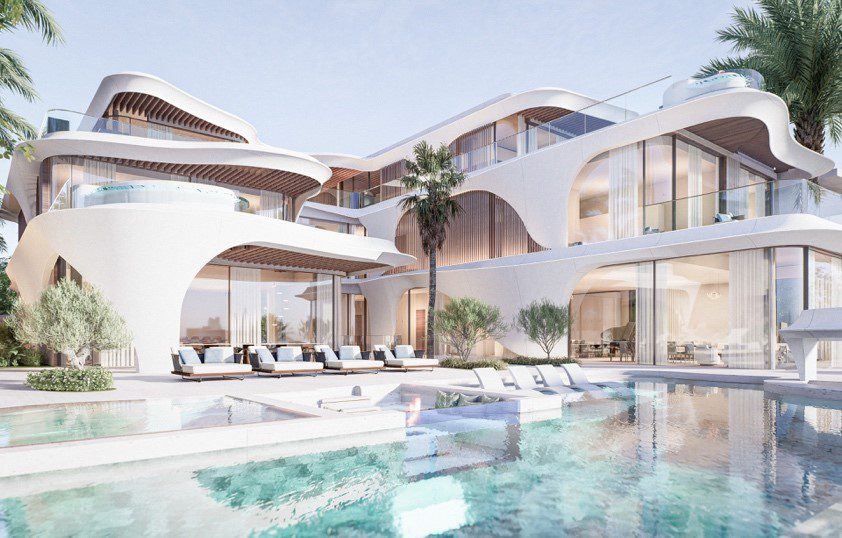
 Miraia sits on the edge of the Gulf as a home shaped by light, reflection and the calming presence of water. Across its terraces and sunken courtyard, water is not a backdrop. It is part of the architectural rhythm, guiding how the home is experienced from the moment you arrive.
From the earliest sketches, the team understood that water would be central to creating the softness and decompression the client hoped for. As you move through the entrance, shallow reflective surfaces sit beneath shaded walkways, cooling the air before it reaches the interior. The sunken courtyard forms the emotional centre of the home, where water, planting and filtered light meet in a quiet, consistent rhythm.
“Water guided the flow of the entire house,” says Lee Nellis, Principal Architect. “It allowed us to create a sense of tranquillity even in the hottest months. The goal was for the architecture to feel like it was breathing.”
Rills cut through limestone and travertine connect the main terrace to the courtyard below. Their scale is small enough to feel intimate but long enough to carry movement through the entire ground floor. The sound is soft and constant, creating a cooling psychological effect that complements the physical temperature drop around the shaded areas.
The upper levels frame the water below, allowing the reflecting surfaces to bounce daylight deep into the living spaces. This creates shifting patterns of light that change with the time of day, adding to the home’s sense of calm. In a region where heat can often dictate how spaces are used, Miraia’s water-led layout allows outdoor terraces and semi covered zones to remain comfortable long after midday.
“Every level has a relationship to water,” says Quinton Murdoch, Associate Architect. “It is either seen, heard or felt. That continuity ties the entire building together.”
The landscaping reinforces this experience. Lush planting surrounds the pool and courtyard edges, softening glare and providing additional evaporative cooling. Margaret Pluta’s planting strategy focused on species that thrive in coastal environments, maintaining comfort while keeping the home visually grounded in its setting.
In Miraia, water is not a decorative luxury. It is a tool of climate, comfort and emotion. A quiet mediator between architecture and environment. A presence that turns a large villa into a place of refuge.
Miraia shows what is possible when water becomes part of the architectural structure itself, not something added at the end. It stands as one of the clearest expressions of our studio’s belief that the best homes are not only seen, they are felt.
Miraia sits on the edge of the Gulf as a home shaped by light, reflection and the calming presence of water. Across its terraces and sunken courtyard, water is not a backdrop. It is part of the architectural rhythm, guiding how the home is experienced from the moment you arrive.
From the earliest sketches, the team understood that water would be central to creating the softness and decompression the client hoped for. As you move through the entrance, shallow reflective surfaces sit beneath shaded walkways, cooling the air before it reaches the interior. The sunken courtyard forms the emotional centre of the home, where water, planting and filtered light meet in a quiet, consistent rhythm.
“Water guided the flow of the entire house,” says Lee Nellis, Principal Architect. “It allowed us to create a sense of tranquillity even in the hottest months. The goal was for the architecture to feel like it was breathing.”
Rills cut through limestone and travertine connect the main terrace to the courtyard below. Their scale is small enough to feel intimate but long enough to carry movement through the entire ground floor. The sound is soft and constant, creating a cooling psychological effect that complements the physical temperature drop around the shaded areas.
The upper levels frame the water below, allowing the reflecting surfaces to bounce daylight deep into the living spaces. This creates shifting patterns of light that change with the time of day, adding to the home’s sense of calm. In a region where heat can often dictate how spaces are used, Miraia’s water-led layout allows outdoor terraces and semi covered zones to remain comfortable long after midday.
“Every level has a relationship to water,” says Quinton Murdoch, Associate Architect. “It is either seen, heard or felt. That continuity ties the entire building together.”
The landscaping reinforces this experience. Lush planting surrounds the pool and courtyard edges, softening glare and providing additional evaporative cooling. Margaret Pluta’s planting strategy focused on species that thrive in coastal environments, maintaining comfort while keeping the home visually grounded in its setting.
In Miraia, water is not a decorative luxury. It is a tool of climate, comfort and emotion. A quiet mediator between architecture and environment. A presence that turns a large villa into a place of refuge.
Miraia shows what is possible when water becomes part of the architectural structure itself, not something added at the end. It stands as one of the clearest expressions of our studio’s belief that the best homes are not only seen, they are felt.
Where Water Becomes a Retreat
In residential projects across the Gulf, water is often the first signal of arrival. Still, reflecting surfaces create a sense of pause. Infinity edges extend the horizon. Courtyard pools cool the air before it enters the home. Common elements include:- Infinity pools that merge sky and water
- Reflecting pools that amplify architecture through light
- Shallow water courts placed beneath shaded terraces
- Semi covered lounges that feel cool even at midday
Rills and Water Channels
In the Gulf, narrow water channels known historically as falaj were used to move water through courtyards and gardens. Their scale and sound brought comfort in extreme heat. Modern interpretations use:- Slim rills cut into stone or limestone paving
- Gentle gradients that create soft, continuous movement
- Shallow channels for safety and clarity
- Edges detailed in granite or travertine
Water Walls and Vertical Cooling
Water walls provide cooling in a different way. Their vertical surface allows water to evaporate as it moves downward, creating a thin cool layer of air around them. Benefits include:- Reducing ambient courtyard temperature
- Enhancing privacy through sound masking
- Acting as a reflective backdrop for landscape
- Moistening dry air in shaded areas
Thermal Comfort and Passive Cooling
Good environmental design always begins with temperature. In the Gulf, this is directly tied to shade, wind movement and water. Our approach integrates:- Water bodies placed in shaded or transitional zones
- Evaporative cooling around shallow pools
- Orientation that directs breezes across water surfaces
- Covered walkways that maintain consistent shade
- Limestone, granite and natural stone for thermal stability
Case Study: Miraia
Miraia sits on the edge of the Gulf as a home shaped by light, reflection and the calming presence of water. Across its terraces and sunken courtyard, water is not a backdrop. It is part of the architectural rhythm, guiding how the home is experienced from the moment you arrive.
From the earliest sketches, the team understood that water would be central to creating the softness and decompression the client hoped for. As you move through the entrance, shallow reflective surfaces sit beneath shaded walkways, cooling the air before it reaches the interior. The sunken courtyard forms the emotional centre of the home, where water, planting and filtered light meet in a quiet, consistent rhythm.
“Water guided the flow of the entire house,” says Lee Nellis, Principal Architect. “It allowed us to create a sense of tranquillity even in the hottest months. The goal was for the architecture to feel like it was breathing.”
Rills cut through limestone and travertine connect the main terrace to the courtyard below. Their scale is small enough to feel intimate but long enough to carry movement through the entire ground floor. The sound is soft and constant, creating a cooling psychological effect that complements the physical temperature drop around the shaded areas.
The upper levels frame the water below, allowing the reflecting surfaces to bounce daylight deep into the living spaces. This creates shifting patterns of light that change with the time of day, adding to the home’s sense of calm. In a region where heat can often dictate how spaces are used, Miraia’s water-led layout allows outdoor terraces and semi covered zones to remain comfortable long after midday.
“Every level has a relationship to water,” says Quinton Murdoch, Associate Architect. “It is either seen, heard or felt. That continuity ties the entire building together.”
The landscaping reinforces this experience. Lush planting surrounds the pool and courtyard edges, softening glare and providing additional evaporative cooling. Margaret Pluta’s planting strategy focused on species that thrive in coastal environments, maintaining comfort while keeping the home visually grounded in its setting.
In Miraia, water is not a decorative luxury. It is a tool of climate, comfort and emotion. A quiet mediator between architecture and environment. A presence that turns a large villa into a place of refuge.
Miraia shows what is possible when water becomes part of the architectural structure itself, not something added at the end. It stands as one of the clearest expressions of our studio’s belief that the best homes are not only seen, they are felt. December 29, 2025
Indoor–Outdoor Living in the Gulf | Climate, Shading and Landscape | Nellis Architecture
December 24, 2025
Designing Stillness on the Sea | 5-Star Single Residence Winner | Nellis Architecture
December 24, 2025
Designing the Extraordinary: Onyx and the Architecture of Confidence
December 22, 2025
25 Questions: The Art of a Good Architectural Brief | Nellis Architecture
December 18, 2025
Water as Experience | Pools, Rills and Thermal Comfort in Gulf Architecture | Nellis Architecture
December 17, 2025
Nellis Architecture 2025 Reflections: Culture, Clarity and the Year of Momentum
December 15, 2025
The Craft of Time: Why Enduring Architecture Matters
November 25, 2025
Sustainable Architecture for Dubai Homes
November 24, 2025
Miraia, Award-Winning 5-Star Single Residence | International Property Awards 2025
November 21, 2025
Heritage and Innovation in Dubai Architecture: How Tradition Meets Modern Design
November 07, 2025
Beachfront Resilience: Salt, Wind, And Glazing
November 01, 2025
AI In Home Design: Useful Or Hype?
September 30, 2025
Quiet Luxury and the Secret of Wabi-Sabi
September 24, 2025
Bespoke Design for Dubai Homes
August 15, 2025
Full Circle Moments and Firsts: A Conversation with Anastasia, Intern at Nellis Architecture
August 11, 2025
Seeing Beyond the Surface: My Journey in Architectural Visualisation
July 22, 2025
When the Brief Comes Pre-Built. A studio reflection with Pieter, Ben and Quinton | Nellis Architecture
July 9, 2025
Introducing Margaret – and Why Landscape Architecture Isn’t Just “Nice to Have”
July 1, 2025
Living Tomorrow: Reflections on the Future of Home Design
June 3, 2025
Building Trust Not Just Buildings: Marketing the Nellis Way
April 14, 2025
How the World Got Smaller: Architecture, Tech, and Keeping Design Real
May 1, 2025
Crafting Light, Telling Stories: A Reflection on Milan Design Week 2025
March 19, 2025
Using Historical Learnings Today
February 2, 2025
Visiting Vitrocsa in Switzerland: Nellis Architecture x GLASSLINE
January 31, 2025
Crafting Wellness at Nellis Architecture: A Year of Reflection and Growth
December 20, 2024
Nellis Architecture X Bauhaus: The Power of Collaboration in Property Projects
December 6, 2024
Lee Nellis: A Journey Through Architecture
November 6, 2024
One-Year Anniversary at Nellis Architecture: A Journey of Vision, Craft, and Growth
November 07, 2025