



Home / News
Mediterranean-Inspired Luxury Home Design Dubai | Residential Architecture UAE | Nellis Architecture
May 30, 2026
Across Dubai’s most recognisable residential communities, from Palm Jumeirah to Emirates Hills, there is a noticeable consistency in how luxury homes present themselves. Large volumes, expansive glazing and polished finishes dominate. These homes are often impressive in scale, yet the experience of living within them can feel less considered than their appearance suggests. This contrast becomes more apparent when viewed alongside Mediterranean architecture, particularly in Spain, where residential design has long been shaped by lifestyle rather than visual impact. These homes are not defined by size, but by how they are used. Movement between spaces feels natural. Outdoor areas are not secondary, but central to daily life. Light is not simply allowed in, it is controlled and shaped. In the UAE, where climate conditions share many similarities with Mediterranean environments, these principles are highly relevant. Yet in many contemporary developments, they are often overlooked in favour of scale and immediate visual clarity. Among Dubai architects and architecture firms in Dubai, there is growing recognition that luxury residential architecture must move beyond surface expression and focus more directly on how people actually live. As Lee Nellis often reflects, a successful home is not one that looks complete, but one that feels complete in use. This requires a shift from designing for visual moments to designing for continuous experience.
Courtyards, Terraces and the Importance of Shade
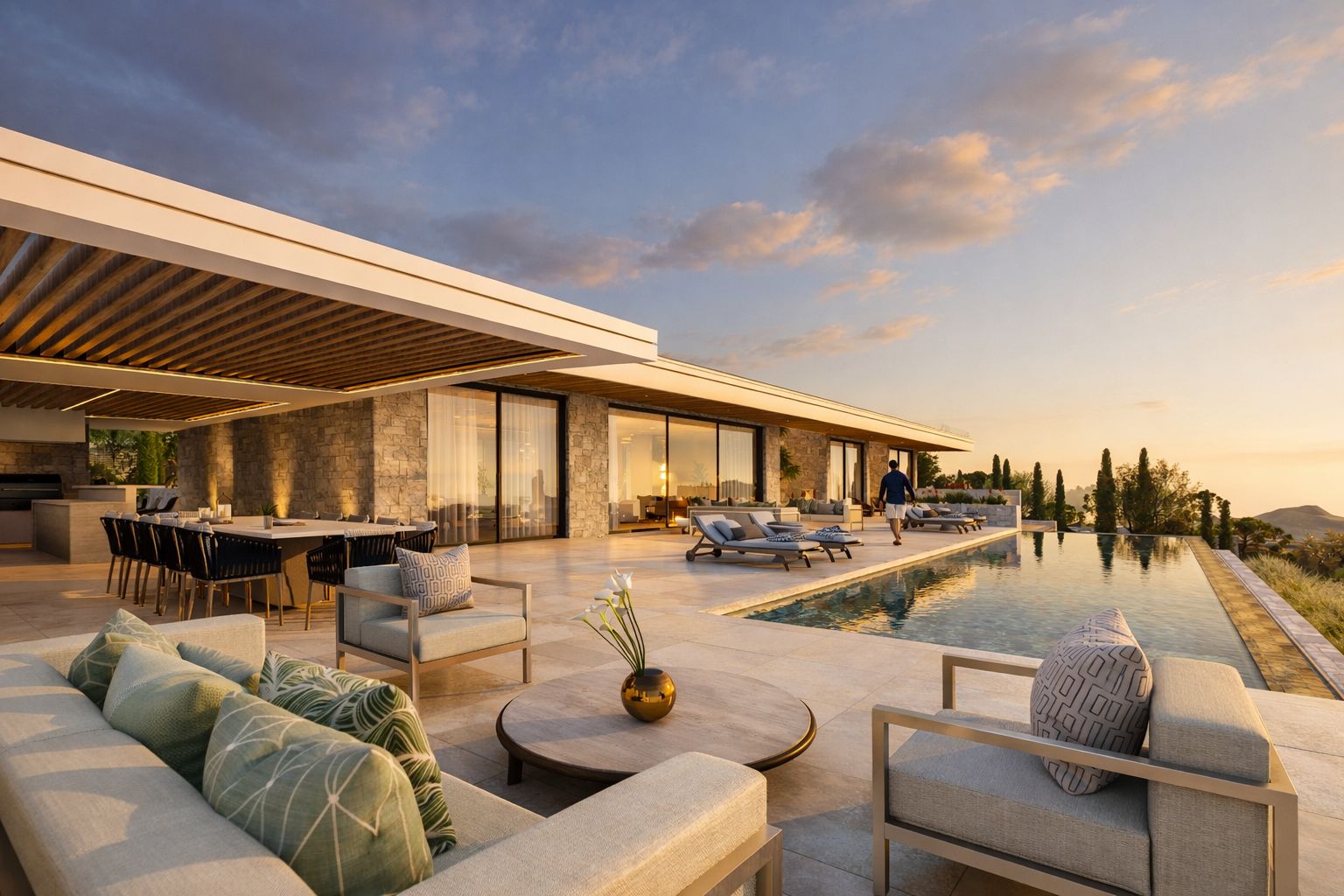
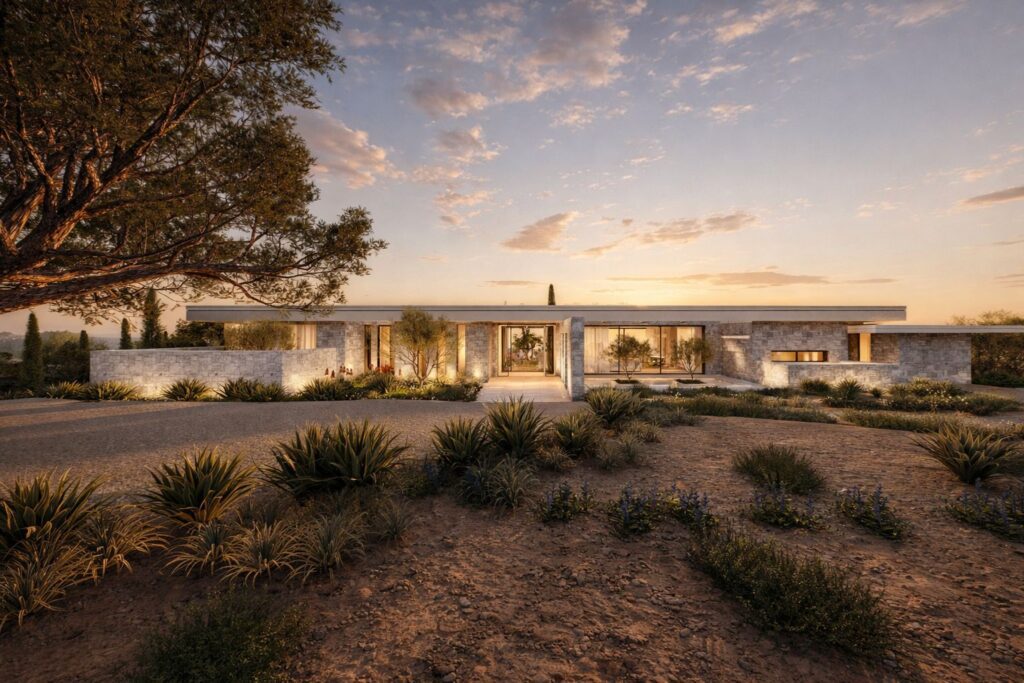 One of the most defining characteristics of Mediterranean architecture is its use of courtyards and terraces. These spaces act as extensions of the interior, creating environments that are both sheltered and open. They are not transitional in the traditional sense, but integral to how the home functions.
In the UAE, where heat and light intensity shape daily behaviour, this approach is particularly relevant. Shaded outdoor areas allow spaces to remain usable throughout the day, rather than only in the early morning or evening. This changes how the home is occupied, encouraging movement between interior and exterior rather than separating them.
In villa design across Palm Jumeirah and Emirates Hills, this principle is increasingly being reinterpreted. Rather than relying solely on large internal spaces, homes are beginning to incorporate layered outdoor areas, shaded courtyards, recessed terraces and semi-enclosed environments that provide relief from direct sunlight.
Architectural design services that prioritise this approach create homes that feel more balanced. The boundary between inside and outside becomes less rigid, allowing for a more fluid lifestyle. Smart home automation can support this by controlling shading systems and adjusting environmental conditions, but the effectiveness of these systems depends on the underlying spatial strategy.
As Margaret Pluta has observed, outdoor space is not an addition to the home, it is part of its structure. When landscape and architecture are considered together, the result is a more cohesive and adaptable environment.
One of the most defining characteristics of Mediterranean architecture is its use of courtyards and terraces. These spaces act as extensions of the interior, creating environments that are both sheltered and open. They are not transitional in the traditional sense, but integral to how the home functions.
In the UAE, where heat and light intensity shape daily behaviour, this approach is particularly relevant. Shaded outdoor areas allow spaces to remain usable throughout the day, rather than only in the early morning or evening. This changes how the home is occupied, encouraging movement between interior and exterior rather than separating them.
In villa design across Palm Jumeirah and Emirates Hills, this principle is increasingly being reinterpreted. Rather than relying solely on large internal spaces, homes are beginning to incorporate layered outdoor areas, shaded courtyards, recessed terraces and semi-enclosed environments that provide relief from direct sunlight.
Architectural design services that prioritise this approach create homes that feel more balanced. The boundary between inside and outside becomes less rigid, allowing for a more fluid lifestyle. Smart home automation can support this by controlling shading systems and adjusting environmental conditions, but the effectiveness of these systems depends on the underlying spatial strategy.
As Margaret Pluta has observed, outdoor space is not an addition to the home, it is part of its structure. When landscape and architecture are considered together, the result is a more cohesive and adaptable environment.
Light and Shadow as Active Design Tools
In Mediterranean architecture, light is not treated as a neutral condition. It is actively shaped through openings, overhangs and material choices. Shadow is used to create contrast, depth and comfort, rather than being eliminated entirely. In many contemporary UAE homes, light is often maximised rather than controlled. Large areas of glazing allow for expansive views, but can also introduce glare and reduce the sense of enclosure. This can make spaces feel exposed rather than comfortable. Luxury home design in Dubai is beginning to shift towards a more considered use of light. Openings are positioned to allow indirect daylight, while shading elements are used to create variation throughout the day. This results in spaces that feel more dynamic and less dependent on artificial lighting. Dubai villa interior design is also evolving in this direction. Interior design companies in Dubai are focusing on how materials interact with light, selecting finishes that soften rather than reflect it. This contributes to a more stable visual environment, reducing the need for constant adjustment. Sustainable architecture in Dubai supports this approach through passive design strategies. By controlling how light enters a space, it is possible to improve thermal performance while also enhancing comfort. These decisions are not always immediately visible, but they significantly influence how a home is experienced over time. Advanced 3D visualisation allows architecture firms in Dubai to test these conditions before construction. By simulating light and shadow, designers can ensure that spaces maintain balance throughout the day, rather than relying on a single moment of visual impact.Texture, Warmth and Everyday Use
Another key aspect of Mediterranean architecture is its use of texture and material warmth. Surfaces are rarely overly polished. Materials such as stone, plaster and timber are used in ways that create depth and variation. This contributes to an environment that feels lived in rather than staged. In many UAE homes, particularly within high-end developments, there is a tendency towards highly refined finishes. While these can appear clean and contemporary, they can also reduce the sense of comfort. Spaces may feel visually complete, but lack the warmth that encourages everyday use. In luxury villa design, this is leading to a reassessment of material selection. Rather than prioritising perfection, there is increasing focus on how materials age and how they respond to light and use. This creates spaces that feel more stable and less dependent on maintenance. Interior design companies in Dubai are working closely with architects to ensure that this consistency is maintained throughout the home. Materials are chosen not only for their appearance, but for how they contribute to the overall experience of the space. Architecture project management in Dubai ensures that these decisions are executed accurately. Small variations in finish or detailing can significantly affect how a space feels, making precision essential. As Quinton Murdoch often notes, a well designed space should support everyday life without requiring constant adjustment. Materials should feel appropriate, not overly controlled.Designing Homes That Support Real Life
The most important lesson from Mediterranean architecture is not stylistic, it is behavioural. Homes are designed around how people gather, move and spend time together. Spaces are not defined by their size, but by their function and relationship to each other. In the UAE, where residential architecture is often driven by scale and visual impact, this represents a meaningful shift. Rather than designing for isolated moments, homes must be designed for continuous use. This includes how spaces connect, how they adapt and how they respond to changing conditions. Long term luxury villa design in Dubai increasingly reflects this thinking. Homes are being designed to support a range of activities, from social gatherings to quiet retreat, without requiring significant reconfiguration. This creates a more resilient and adaptable environment. Smart home automation enhances this by allowing spaces to respond to behaviour, adjusting lighting, temperature and shading as needed. However, these systems are most effective when they are integrated into a design that already supports the intended lifestyle. As Lee Nellis often notes, the measure of a home is not how it appears at completion, but how it is used over time. The most successful spaces are those that feel natural to inhabit, not because they are simple, but because they are aligned with how people live. We design homes for real life, not just visual impact.How Dubai Climate Shapes Every Decision a Luxury Architect Makes
Aug 14, 2026
Why International Clients Continue to Choose Dubai for Bespoke Residential Architecture
Aug 11, 2026
Can Architecture Make a Luxury Brand More Desirable? The Psychology Behind Premium Retail Design
July 30, 2026
Designing Oceanfront Homes That Feel Private Without Closing Off the View
July 28, 2026
Contemporary Luxury Architecture: What the World’s Best Homes Have in Common
July 9, 2026
Systems Thinking in Architecture: Designing Systems, Not Just Villas
July 7, 2026
UAE Architecture During Global Uncertainty: How Dubai’s Architecture Sector Continues to Grow Through Global Change
July 6, 2026
Architecture and Identity in the UAE | Contemporary Middle Eastern Design | Nellis Architecture
July 5, 2026
Contemporary Luxury Architecture: What the World’s Best Residential Homes Have in Common
July 2, 2026
Dubai as a Global Design Base | Luxury Architect Dubai | Nellis Architecture
June 28, 2026
Smart Home Automation Dubai | What Belongs in a Luxury Villa | Nellis Architecture
June 3, 2026
Designing for Balance, What Traditional Chinese Architecture Teaches Modern UAE Homes
May 31, 2026
Behaviour-Led Luxury Home Design Dubai | Residential Architecture UAE | Nellis Architecture
May 30, 2026
Mediterranean-Inspired Luxury Home Design Dubai | Residential Architecture UAE | Nellis Architecture
May 25, 2026
When Design Is Tested What Actually Matters | Luxury Villa Design Dubai | Nellis Architecture
May 18, 2026
Beyond Aesthetics: Designing Spaces That Last | Luxury Home Design Dubai | Nellis Architecture
May 15, 2026
Architectural Design Across the UAE | Luxury Home Design Dubai | Nellis Architecture
May 8, 2026
How We Approach Dubai Villa Interior Design on Palm Jumeirah | Nellis Architecture
May 6, 2026
How to Choose an Architecture Firm in Dubai | Luxury Villa Design UAE | Nellis Architecture
April 6, 2026
Why Longevity Is Becoming the New Definition of Luxury
April 4, 2026
The Islamic Garden Principles in Contemporary Palm Jumeirah Villa Design
April 2, 2026
The Difference Between Expensive and Valuable in Luxury Architecture
March 30, 2026
The Architecture of Shade in the UAE
March 27, 2026
Living With the Sea: What Coastal Architecture Really Requires on Palm Jumeirah
March 24, 2026
From Mashrabiya to Modern Screens: Privacy in Architecture and What It Means for Dubai Villas Today
February 15, 2026
What Makes a Palm Villa Truly Luxury | Luxury Villa Design Dubai | Nellis Architecture
February 14, 2026
Modern vs Contemporary Villas on the Palm | Luxury Villa Design Dubai | Nellis Architecture
February 13, 2026
How to Maximise Views Without Sacrificing Privacy | Luxury Villa Design Dubai | Nellis Architecture
February 3, 2026
Future-Proofing a Palm Jumeirah Home | Luxury Villa Design Dubai | Nellis Architecture
January 25, 2026
Common Mistakes When Building High-End Homes in Dubai | Luxury Villa Design | Nellis Architecture
December 29, 2025
Indoor–Outdoor Living in the Gulf | Climate, Shading and Landscape | Nellis Architecture
December 24, 2025
Designing Stillness on the Sea | 5-Star Single Residence Winner | Nellis Architecture
December 24, 2025
Designing the Extraordinary: Onyx and the Architecture of Confidence
December 22, 2025
25 Questions: The Art of a Good Architectural Brief | Nellis Architecture
December 18, 2025
Water as Experience | Pools, Rills and Thermal Comfort in Gulf Architecture | Nellis Architecture
December 17, 2025
Nellis Architecture 2025 Reflections: Culture, Clarity and the Year of Momentum
December 15, 2025
The Craft of Time: Why Enduring Architecture Matters
November 25, 2025
Sustainable Architecture for Dubai Homes
November 24, 2025
Miraia, Award-Winning 5-Star Single Residence | International Property Awards 2025
November 21, 2025
Heritage and Innovation in Dubai Architecture: How Tradition Meets Modern Design
November 07, 2025
Beachfront Resilience: Salt, Wind, And Glazing
November 01, 2025
AI In Home Design: Useful Or Hype?
September 30, 2025
Quiet Luxury and the Secret of Wabi-Sabi
September 24, 2025
Bespoke Design for Dubai Homes
August 15, 2025
Full Circle Moments and Firsts: A Conversation with Anastasia, Intern at Nellis Architecture
August 11, 2025
Seeing Beyond the Surface: My Journey in Architectural Visualisation
July 22, 2025
When the Brief Comes Pre-Built. A studio reflection with Pieter, Ben and Quinton | Nellis Architecture
July 9, 2025
Introducing Margaret – and Why Landscape Architecture Isn’t Just “Nice to Have”
July 1, 2025
Living Tomorrow: Reflections on the Future of Home Design
June 3, 2025
Building Trust Not Just Buildings: Marketing the Nellis Way
April 14, 2025
How the World Got Smaller: Architecture, Tech, and Keeping Design Real
May 1, 2025
Crafting Light, Telling Stories: A Reflection on Milan Design Week 2025
March 19, 2025
Using Historical Learnings Today
February 2, 2025
Visiting Vitrocsa in Switzerland: Nellis Architecture x GLASSLINE
January 31, 2025
Crafting Wellness at Nellis Architecture: A Year of Reflection and Growth
December 20, 2024
Nellis Architecture X Bauhaus: The Power of Collaboration in Property Projects
December 6, 2024
Lee Nellis: A Journey Through Architecture
November 6, 2024